
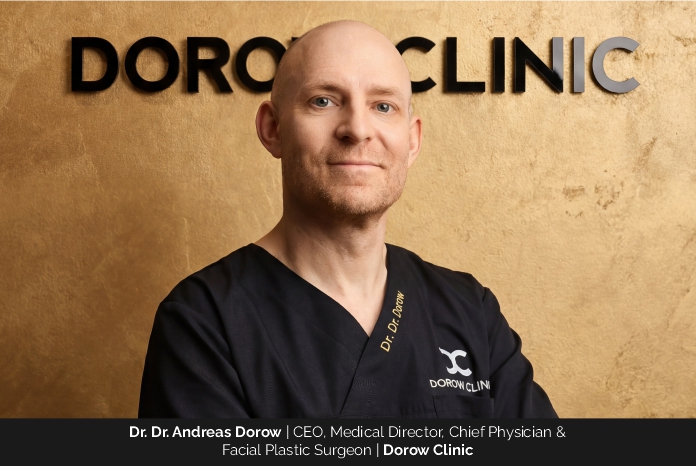
Social media and viral trends are driving new beauty expectations. But Dr. Dr. Andreas Dorow, Chief Physician and Medical Director of Dorow Clinic, does not allow momentarily popular aesthetics to dictate his practice. He believes that true quality arises not from trends but from experience, precision, and a deep understanding of natural aesthetics.
Working like an aesthetic architect, he translates patients’ desires for aesthetic interventions into results that are natural, enduringly harmonious, and true to their anatomy. Instead of erasing their natural radiance, he enhances it in a way that makes it timeless.
Dr. Dorow has constructed a fully integrated medical system anchored in scientific rigor, artistic intelligence, and moral restraint. He has shaped Dorow Clinic into a model for how aesthetic medicine should function over the long term. In an industry known for transience, Dr. Dorow creates what endures.
From a Remote Mountain Region to Defining Modern Aesthetic Medicine
Dr. Dorow, the eldest of five children, grew up in a structured family environment in a remote, mountainous region of southern Germany. As the only boy among four younger sisters, he learned what it meant to be responsible early in life.
“I learned to observe carefully and take responsibility from a young age,” he says. He also learned to anticipate needs and protect quietly. This sense of responsibility, along with a penchant for precision, shaped his path into medicine.
One person who greatly influenced Dr. Dorow during his growing-up years was his grandfather. A master craftsman, he taught him that even the smallest detail can determine the outcome. He would often visit his grandfather’s workshop, where he became familiar with the nuances of craftsmanship, which later proved valuable in his medical career.
In the workshop, he came to appreciate the values of patience, precision, and respect for material. He saw that a “fraction of a millimeter could determine success or failure.” Mistakes could not be undone; there were no filters and no opportunity for correction. There were only consequences.
Dr. Dorow’s exposure to the craftmanship also shaped his relationship with his hands. Because of that, long before he held surgical instruments, he understood resistance, structure, balance, and permanence. Precision, he came to believe, was a moral discipline and not a technical skill.
Dr. Dorow was drawn to both art and science. He never considered them opposing forces. He describes them as “complementary languages” expressing the same truth. So, in addition to his technical grounding, he developed an exceptional artistic ability. Later, as an award-winning painter and sculptor, he cultivated a deep sensitivity to proportion, symmetry, and spatial harmony.
This combination of technical expertise and artistic talent would later define his distinctive surgical approach. According to Dr. Dorow, his dual passion for science and art guided him toward medicine, a field where both precision and aesthetics play a role.
“Founding Dorow Clinic was a natural evolution of this journey,” he says. He intended to create a place where medical excellence, interdisciplinary collaboration, and a strong ethical foundation come together.
Serving in a Demanding Environment
Dr. Dorow holds doctoral degrees in both medicine and dentistry, a rare combination in fields typically pursued separately. Only a few physicians follow this dual path. He also trained under conditions where medicine was not “elective, cosmetic, or negotiable.” According to Dr. Dorow, his “most decisive education” took place at the German Army Hospital in Ulm.
There, he treated war victims, severely injured soldiers, children with complex congenital deformities, and patients suffering from advanced tumors. As in his grandfather’s workshop, outcomes in the hospital were irreversible, and decisions were final. Improvisation had no place here, and ego even less.
While working in this demanding environment, Dr. Dorow gained a deeper understanding of medicine. For him, it became a moral responsibility instead of a service industry. Beauty, he concluded, could never exist independently of function. Additionally, he believed that aesthetic outcomes had to be governed by the same principles as reconstructive surgery: anatomical integrity, functional correctness, and long-term stability.
Viewing Aesthetic Medicine as a Risk
When Dr. Dorow first entered the field of aesthetic medicine, he regarded it as a risk, specifically the risk of oversimplification and fragmentation. He was also concerned that the human face might be reduced to a series of isolated interventions and not considered a living, aging system.
Moreover, Dr. Dorow noted that the challenge that plagued aesthetic medicine worldwide was not a lack of technical skill but rather a failure of integration. Not much has changed since then. He points out that dentistry, maxillofacial surgery, plastic surgery, dermatology, and non-surgical aesthetics often operate in parallel silos despite treating the same anatomical structures. Also, according to him, each discipline optimizes its own outcomes without adequately accounting for the interactions of interventions over time. This results in short-term satisfaction coupled with long-term disharmony, producing outcomes in which faces appear treated rather than harmonized.
Dr. Dorow firmly believes that true excellence demands a systemic approach.
Defining Experience: Humanitarian Work in Pakistan
Dr. Dorow considers his humanitarian work in Pakistan the most defining experience of his professional life. It reinforced his resilience and belief that medicine must always serve function first.
He traveled to Pakistan to treat children with cleft lip and palate. According to him, this work was not an extension of the Dorow Clinic’s commercial operations nor part of a permanent foundation. It was a personal commitment that reaffirmed his belief that medical skill carries ethical weight regardless of geography or compensation.
The families he served didn’t belong to a privileged class. For them, cleft repair surgery was not a cosmetic procedure. It was transformative. Every intervention was life-changing, as they determined whether a child could eat, speak, attend school, or be accepted socially. Each operation restored not just anatomy, but dignity, according to Dr. Dorow. In addition to restoring children’s health, it instilled confidence in them and opened doors of opportunities that would have otherwise remained shut. Dr. Dorow says that the experience was grounding.
It left a lasting imprint on his philosophy that medicine, at its highest level, must always serve function first. He explains that aesthetics, when done responsibly, are simply another expression of that same principle. “In that environment, medicine returned to its core purpose,” Dr. Dorow points out.
Brief Introduction to Dorow Clinic
Dr. Dorow and his wife, Sonia Ashkenazy, founded Dorow Clinic in 2006, near the German–Swiss border, strategically positioned close to Zurich and at the heart of Europe. They were driven by a vision of a clinic that would operate as a unified medical ecosystem, which followed one philosophy, one standard, one uncompromising commitment to quality. Integration was not branding. It was the law. Nearly two decades later, that vision has scaled without erosion.
Dorow Clinic is one of the most advanced and comprehensive institutions in aesthetic medicine in Europe. It unites plastic surgery, maxillofacial surgery, dentistry, dermatology, non-surgical aesthetics, and longevity medicine under a single philosophy. The clinic offers a comprehensive spectrum of procedures, from complex facelifts and rhinoplasty to dental reconstruction and conservative non-surgical treatments.
What distinguishes Dorow Clinic internationally is its integration of dentistry with facial aesthetics. Dr. Dorow points out that Dental architecture is designed in harmony with skeletal structure, soft tissue dynamics, and aging trajectories. Additionally, Dorow Clinic is shaping the future through evidence-based longevity medicine, preventive diagnostics, advanced skincare, and medically supervised weight management. Longevity, in Dorow’s framework, is not anti-aging. It is a strategic investment in vitality, autonomy, and quality of life.
Today, Dorow Clinic operates nine locations across Germany and Switzerland, employs more than 370 staff members, and brings together over 40 highly specialized physicians. It is the largest integrated center combining aesthetic dentistry and plastic surgery in the German-speaking world.
Yet despite its size, the clinic maintains a boutique mentality. Growth is deliberate. Oversight is centralized. Standards are non-negotiable. And one of the clinic’s most defining principles is its willingness to say no. According to Dr. Dorow, they do not accept every request, nor do they perform every procedure. If they determine that an intervention does not align with medical responsibility, psychological stability, and long-term harmony, they decline the request for treatment. For international patients accustomed to limitless choice, this discernment often becomes the ultimate marker of luxury.
The clinic attracts patients from across Europe, the United States, and South America. Public figures have sought treatment at the clinic. Dr. Dorow, however, does not measure success in those terms. Even though they have treated 150,000 patients and received over 1,500 verified top-tier reviews, trust, rather than visibility, continues to be the ultimate metric under his exemplary leadership.
Culture of Innovation and Collaboration
When it comes to innovation, Dr. Dorow is clear that “innovation must never come at the expense of the patient.” So, at Dorow Clinic, they evaluate every new approach through the lens of safety, anatomical integrity, and long-term outcomes.
“Our goal is not to be the fastest, but to be the most precise and responsible,” Dr. Dorow points out. “Innovation is valuable only when it improves patient care in a sustainable way.”
And, to ensure that innovation is driven by expertise and accountability, Dr. Dorow and his team encourage continuous learning and responsibility at every level.
Additionally, they have built a culture based on shared standards, open communication, and interdisciplinary collaboration. Dr. Dorow says that integration is not a concept for them. It is a principle they apply every day at work.
At Dorow Clinic, he has built a culture where excellence is expected, restraint is respected, and responsibility governs every decision.
Work and Personal Life Alignment
For Dr. Dorow, work-life balance is not about separation but about alignment. He points out that his family, who play a central role in his life, reflects the values that also define the clinic. These values are discipline, curiosity, and responsibility.
“This alignment allows me to lead with clarity and purpose, both professionally and personally,” Dr. Dorow says.
Vision and Plan for the Future
Dr. Dorow has no intention of slowing down. He intends to continue developing Dorow Clinic as a leading integrated medical system that sets new standards in precision, safety, and long-term outcomes.
More broadly, he believes that the future of healthcare lies in systems that combine science, ethics, and interdisciplinary collaboration. He foresees systems designed with intention rather than driven by trends.
Modern Healthcare Challenge
Dr. Dorow notes that fragmentation of medical disciplines continues to be a major challenge in healthcare. Different specialties often operate in isolation, even though they treat the same anatomy. As he pointed out earlier, this lack of integration can lead to short-term results but long-term disharmony. “The future of healthcare lies in interdisciplinary systems that consider the patient as a whole,” Dr. Dorow says.
Global Healthcare Trends
Dr. Dorow believes that global trends such as longevity medicine, preventive care, and personalized treatments will significantly shape the future. However, according to him, the key will be integrating these advancements into a structured, patient-centered system rather than adopting them in isolation.
As an influential figure in aesthetic medicine, he hopes to contribute to a shift toward more responsible, integrated, and ethically grounded medicine.
“For future physicians, this means understanding that excellence requires both technical skill and moral discipline,” Dr. Dorow explains. “For patients, it means receiving care that prioritizes long-term health and well-being.”
Advice for Aspiring Leaders in Healthcare
Dr. Dorow advises aspiring leaders to focus on depth, not speed. He encourages them to develop true expertise, maintain integrity, and always prioritize the patient.
“Leadership in healthcare is not about visibility,” he adds. “It is about responsibility and consistency over time.”
The Legacy Talk
Dr. Dorow’s work makes one thing clear: the future of aesthetic medicine belongs to those who design with intention, integration, and integrity. As for his legacy, he has never measured it in square meters, patient numbers, or expansion charts. Instead, Dr. Dorow measures it through the continuity of values, evident in the passing on of discipline, curiosity, and responsibility across generations.