
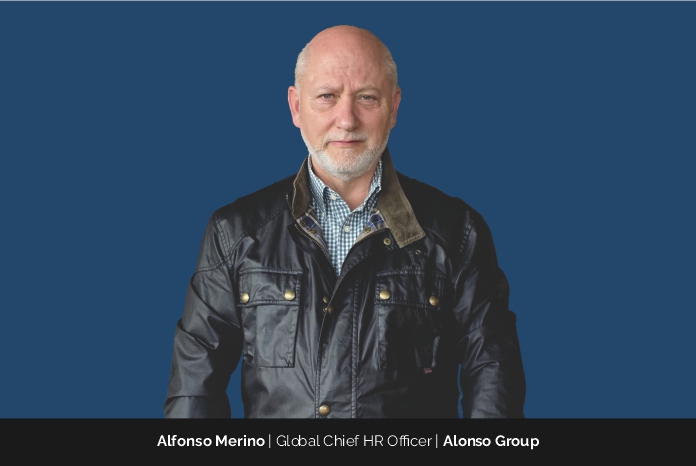
Few HR leaders can claim a career as illustrious and influential as Alfonso Merino, Global Chief HR Officer at Grupo Alonso. Over more than 25 years, he has led human resources across five vastly different industries: hospitality, technology, consulting, industrial, and logistics, accumulating experience and insights that few in the field can match. He has shown that HR, when done right, is more than a support function. It is a force that drives business growth, unlocks human potential, and creates lasting organizational change.
Alfonso does not define success in terms of operational metrics such as time-to-hire or cost-per-hire. For him, success is when the talent attracted not only meets objectives but also elevates those around them, grows professionally, and contributes to transforming the organization. It is also, he says, the ability to build resilient and adaptable teams in very different environments.
“The true success is positioning HR as a strategic engine for sustainable growth,” Alfonso says.
A Career Built Across Industries
In a career spanning more than 25 years, Alfonso has established himself as one of the most inspirational HR leaders. It is primarily because of his passion for people.
“My passion for people and talent acquisition has been forged through a progressive career across very different sectors,” he says.
He began his career in the hospitality sector, where he managed teams in environments of high turnover, multiculturalism, and demanding customer service. It was while working in this sector that he understood that people’s emotional commitment is the true competitive differentiator.
Alfonso then moved to the technology sector, where he led the attraction of highly specialized profiles in an extremely competitive and constantly evolving market. After that, he served in consulting. There, he delved deeper into the alignment between business and talent strategies at the international level. Later, he joined the industrial sector and faced large-scale restructuring processes, mergers, and operational transformations.
“Finally, in the logistics and services sector, where I currently serve as Global Chief HR Officer,” Alfonso says, “I integrate all these experiences to manage complex organizations that are globally distributed and subject to high operational volatility.”
He also points out that the different stages of his career have taught him that talent acquisition is not an administrative function but a strategic discipline that combines empathy, data, business vision, and anticipation of the future.
“My passion remains intact because each sector has shown me that people are the only irreplaceable asset,” he adds.
Personal Values Serving as Constant Compass
Throughout Alfonso’s career, personal values such as integrity, absolute respect for human dignity, justice, and a commitment to continuous development have served as his constant compass. From his beginnings in the hospitality sector, where human interaction is essential, to the high demands of the technology and consulting sectors, through the operational challenges of industry, and now the global complexity of logistics, these values have prevented him from resorting to short-term solutions.
“I have always defended models that combine high operational demands with strong support for people’s development,” he says.
According to Deloitte’s “Global Human Capital Trends 2025/2026,” 84% of employees consider purpose and trust to be the main factors in retention. This finding validates Alfonso’s approach to global HR strategies based on transparency, equity, and ethical governance, specifically in the responsible adoption of technologies such as AI.
Most Challenging Transformation
For Alfonso, the most challenging transformation was the digital and cultural shift triggered by the COVID-19 pandemic.
Overnight, he found himself leading a shift away from face-to-face models toward hybrid and globally distributed environments, in addition to ensuring productivity, cohesion, and well-being.
Alfonso recalls those days as a difficult yet exciting time. He credits his exceptionally committed team and the rest of the workforce with making the transition easier despite the challenges.
He and his team, according to him, could manage it successfully through a phased approach: deep diagnosis with active listening, co-creation with local leaders, transparent communication, and continuous measurement. They also implemented “Hybrid Leadership” and “Work-related Learning Empowerment” programs.
According to PwC and Deloitte, the success of these transformations depends on the CHRO’s direct involvement. Agreeing with that view, Alfonso points out that treating change as a deeply human process was the key to a successful transition.
Achievement: Long-term Talent Pipeline Programs
Among Alfonso’s most standout achievements is the design and implementation of long-term Talent Pipeline programs. These initiatives perfectly align capability planning with expansion and digital transformation strategies.
Such a model has significantly increased internal hiring and mobility, reducing dependence on external talent and directly contributing to improvements in operational results and competitiveness.
“It demonstrated that a well-executed people strategy is one of the greatest levers for business growth,” Alfonso points out.
Global Chief HR Officer’s Responsibilities and Principles
As Global Chief HR Officer, Alfonso’s main responsibility is to act as a strategic partner to the Executive Committee. In this role, he ensures that the talent strategy directly supports the organization’s growth, competitiveness, and sustainability objectives in multinational environments.
His experience has taught him to balance vision with disciplined execution. As a result, he dedicates between 60% and 65% of his time to strategic matters, such as succession planning, cultural transformation, and predictive workforce planning. The rest of the time, he devotes himself to ensuring operational excellence in the HR area and empowering local teams
Throughout his career, Alfonso has implemented skills, intelligence models, and predictive dashboards that have improved decision-making, adapting them to the particularities of each sector, from the seasonality of hospitality to the high volatility of logistics.
And the principles that anchor Alfonso as a leader are non-negotiable integrity, permanent curiosity, a long-term focus, and the deep conviction that people are the only truly irreplaceable asset. “Leading from these principles is the only way to build sustainable, competitive, and dignified organizations in the 21st century,” he says.
Innovative Practices to Attract and Retain Talent
Alfonso believes that talent retention cannot be achieved with isolated initiatives; it requires a comprehensive ecosystem that places people at the very core and as the driving force of the business.
In order to ensure that, he has promoted a set of innovative practices that combine technology, organizational culture, and a deep understanding of the expectations of new generations and senior talent. This enables him to attract and retain the best people.
Some of the key practices that have been introduced throughout their career include:
- “Liquid Careers” Systems based on skills (Skills-First Approach)
Alfonso and his team have moved from traditional models based on fixed positions and rigid hierarchies to a liquid careers system. This allows people to develop through projects, rotations, and cross-functional missions according to their competencies and aspirations. Skills intelligence platforms are used to map each collaborator’s capabilities in real time and compare them with the organization’s future needs.
Alfonso points out that this has significantly increased internal mobility and reduced frustration among professionals who feel “boxed in.”
- Internal AI Talent Marketplace
This initiative implemented an internal digital marketplace powered by artificial intelligence that functions as a “talent exchange” where strategic projects can search for and attract internal talent agilely. Employees can apply to opportunities that align with their development interests, even outside their area or country. Alfonso says that this practice has notably improved retention by providing a sense of movement and continuous growth without needing to change companies.
- Reverse Mentoring and Circular Mentoring Programs
In addition to traditional mentoring, Alfonso and his team have established structured reverse mentoring programs and circular mentoring. Reverse mentoring programs offer junior talent or younger generations the opportunity to advise senior leaders on technology, social trends, and new ways of working. Circular mentoring allows everyone to learn from everyone. Alfonso explains that these programs have strengthened a bidirectional learning culture and improved intergenerational connection.
- Highly Personalized Total Rewards Platforms
This innovative practice has allowed Alfonso and his team to move beyond standard compensation packages. Through a digital platform, each person can configure their own flexible compensation package, combining salary, bonuses, physical and mental health benefits, additional time off, volunteering opportunities, study support, and even options to invest in training or wellness. Alfonso says that this personalization has proven especially attractive for attracting and retaining diverse talent.
- Experiential Onboarding and High-Impact Pre-boarding
He and his team design incorporation processes that begin weeks before the official start date, with cultural connection sessions, meetings with future colleagues, and early assignment of a “buddy” and mentor. They include experiential elements such as gamification and real project assignments from the first weeks. According to Alfonso, the result has been a drastic reduction in turnover during the first six months.
- Internal Reskilling Academies and Continuous Micro-credentials
This initiative has created corporate academies in partnership with leading universities and technology platforms, offering personalized training pathways with recognized micro-credentials. Directly linked to business strategy and future skills projections, these programs proactively prepare people for technological and market changes.
- Recognition and Continuous Feedback Platforms with Gamification
This has led to the implementation of real-time recognition systems where anyone can give and receive public recognition, with gamification elements and meaningful rewards. Alfonso points out that this has strengthened the sense of belonging and improved engagement.
- “Talent Communities” and Alumni Networks
Through this initiative, Alfonso maintains active talent communities, even with professionals who have moved on. Complementing this is a robust “boomerang hires” program that welcomes back former employees who have gained new experience elsewhere.
“All these practices are supported by strong ethical governance and the responsible use of data and AI, always with a ‘human-in-the-loop’ approach,” Alfonso says, “We do not see them as isolated initiatives, but as integral parts of a coherent and comprehensive employee experience.”
He also highlights that the results have been very positive. They have significantly improved critical talent retention rates, reduced time-to-fill for key positions, and raised internal engagement levels. Alfonso points to recent studies by Gallup, Deloitte, and Mercer, which show that organizations that combine skills-based practices with personalized experiences and continuous growth opportunities outperform their competitors’ retention rates by up to 30-40%.
“In short, my philosophy is clear: talent is not retained with isolated benefits,” Alfonso adds. “It is retained by creating an organization where people feel they are growing, that they matter, and that their contribution has real purpose.”
He underscores that innovation in HR must serve that human aspiration.
How to be an Employer of Choice in 2026
In order to be an employer of choice in 2026, Alfonso says organizations need an authentic, coherent, and continuously evolving Employee Value Proposition (EVP). From his time in hospitality, where the employee experience directly impacts the customer experience, to his current role in logistics, he has learned that competitive compensation is not enough. “You must offer real skills development, flexibility, purpose, and professional growth,” he says.
Data from Gallup’s “State of the Global Workplace 2026” indicates that only 20% of employees worldwide are truly engaged. In this regard, Alfonso believes it is essential to work with skills-based career programs, international mobility, and high-impact onboarding. He adds that skills-based hiring and personalized benefits have proven especially effective across technology, consulting, industrial, and logistics environments.
Culture of Inclusion and Belonging
Alfonso points to McKinsey studies that indicate that organizations with high levels of inclusion generate up to 35% more profitability and greater innovation.
He strives to foster inclusion through globally consistent policies adapted locally, Employee Resource Groups (ERGs), mandatory unconscious bias training, diversity metrics included in executives’ objectives, and transparent communication.
“The sense of belonging is built through authentic recognition, equitable opportunities, and psychologically safe environments,” Alfonso explains. “This is especially relevant in highly diverse teams.”
Impact of Technology and Data on Talent Acquisition
Alfonso notes that technology and data are radically changing talent acquisition. They are making it more predictive and proactive and less reactive. Alfonso also points out that tools such as talent intelligence, agentic AI, and advanced analytics allow them to identify passive candidates, map skills gaps in real time, and predict cultural and performance fit with great precision. “Throughout my career,” he adds, “these tools have proven especially valuable in high-volatility environments.”
Alfonso expects investment in AI for HR to grow exponentially. He, however, firmly defends a “human-in-the-loop” approach. “Technology accelerates processes and reduces biases, but final decisions in key roles must remain human,” he points out.
Influencing the Next-Gen of HR Professionals
In the AI-driven era, Alfonso hopes to leave a legacy of strategic, ethical, and deeply human leadership in HR. He wants to inspire the next generation to see Human Resources not as a support function, but as the most transformative function in an organization.
“HR builds organizations where people grow, companies thrive, and society advances,” Alfonso says.
Advice to Aspiring HR Leaders
As someone who has served in different sectors, Alfonso advises aspiring HR leaders to gain an understanding of business operations across different sectors. He encourages them to master data, analytics, and technology without ever losing empathy or human connection.
Alfonso also points out that leaders sometimes have to defend the right decisions even if those decisions are unpopular.
“And above all, learn continuously and never forget that the best HR professional is the one who unlocks people’s potential so they can give their very best,” he adds.